“Sit still and immovable in Samadhi (Sanskrit: absorption, concentration) and think from the reason of non-thinking. How can one think from the reason of non-thinking? Non-thinking. That is the art of Zazen. Zazen is not the learning of concentration. It is the Dharma gate to great ease and joy. It is immaculate practice-enlightenment."
-Dogen, "Rules of Zazen: Zazen-gi"
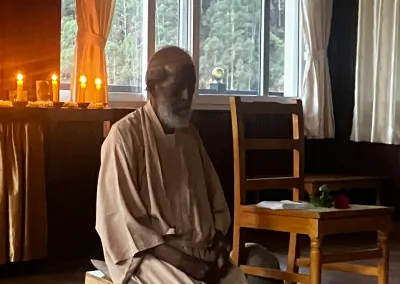
Zazen, sitting meditation, is the fundamental practice of Zen. In Soto Zen, it is called Shikantaza, simply sitting. Zazen has three dimensions: body posture, breathing, and mental attitude and vision.
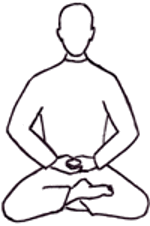
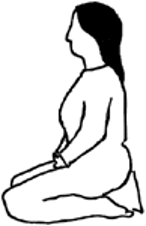
Take a good, comfortable posture. Take a posture according to your physical conditions: full, half or quarter lotus, burmesian or seiza posture. You can also sit on a chair, preferably with some back rest for the lower back, your feet firmly planted on the floor. Let your whole-body rest on the cushion and the floor. Keep your back straight, with lower back a bit curved forward.Let your head be held up, with chin a bit in. Let your shoulders be relaxed and the chest open. Hold your body loose and relaxed but steady, straight up and firm.
If your legs go to sleep, adjust a bit their position to relieve the pressure and avoid sleeping legs. Often you may feel tension in some part of the body, particularly neck, shoulders, lower back. Ease the part if it is cramped or held tight. But do not try deliberately to do something to that part of the body.
After that, just be, let-be and be aware.
Hands and palms in the usual Zen mudra, resting close to the lower belly. If this is a strain for you, just hold your hands resting on your lap.
Let your eyes be slightly open and relaxed, looking down in front of you a few feet away, blinking as usual, without staring at any point. At times it is all right to close your eyes. Hence, keeping one’s eyes open calls one to be aware, to be here and now, to let be and be present to whatever happens to one.
During kinhin (walking meditation), hold your body loose and flexible, be aware of your body and the walking movements, and be also aware of your breathing rhythm, eyes gently looking downward in front, hands in the kinhin mudra.
The way you breathe involves your basic attitude to life. In Zen one does not try to control one’s breath. One breathes normally but in a healthy way. However, focusing on the outgoing breath or exhalation is very helpful. Further, abdominal breathing is recommended. Focus on the out-breath, and breathe out long, slow and steady, and let the incoming breath flow normally and gently and of shorter duration. You can exhale to the count of one to ten; it helps for concentration or samadhi. After a while, such breathing will become normal and natural to you. Do not try to force deep breathing.
Thoughts are a natural part of the human experience. When thoughts arise, acknowledge them without judgment. Treat them like clouds passing through the sky.
As the quote from Dogen at the beginning shows, zazen is not one of doing or achieving; it is not a method or technique. Zazen is not simply concentration or samadhi practice or getting into some trance state. The physical posture of zazen can be said to be the door opening into the spirit of zazen. But Zazen is more than a physical posture or a particular experience or a particular state of mind. Zazen is a form of healing affirmation, it is letting-be and be-ing.
When you do zazen, it is the universe that is doing zazen, it is Buddha who is practicing.
Zazen embraces all times and spaces and at the same time it is timeless and spaceless.